


Feeling lost in the unpredictable world of dating?
People with the ISTJ personality type (Logisticians) often find the unpredictable nature of dating and relationships challenging. Romance rarely follows a strict set of guidelines or a specific timeline, and emotions take center stage where logic may not always apply. It’s normal to feel confused, hopeless, scared, or even overwhelmed at times – in fact, 67% of ISTJs say that falling in love scares them.
But as an ISTJ, you bring many admirable strengths to your romantic life. Your reliability, loyalty, and grounded nature can make you an excellent partner. Finding authentic love is possible.
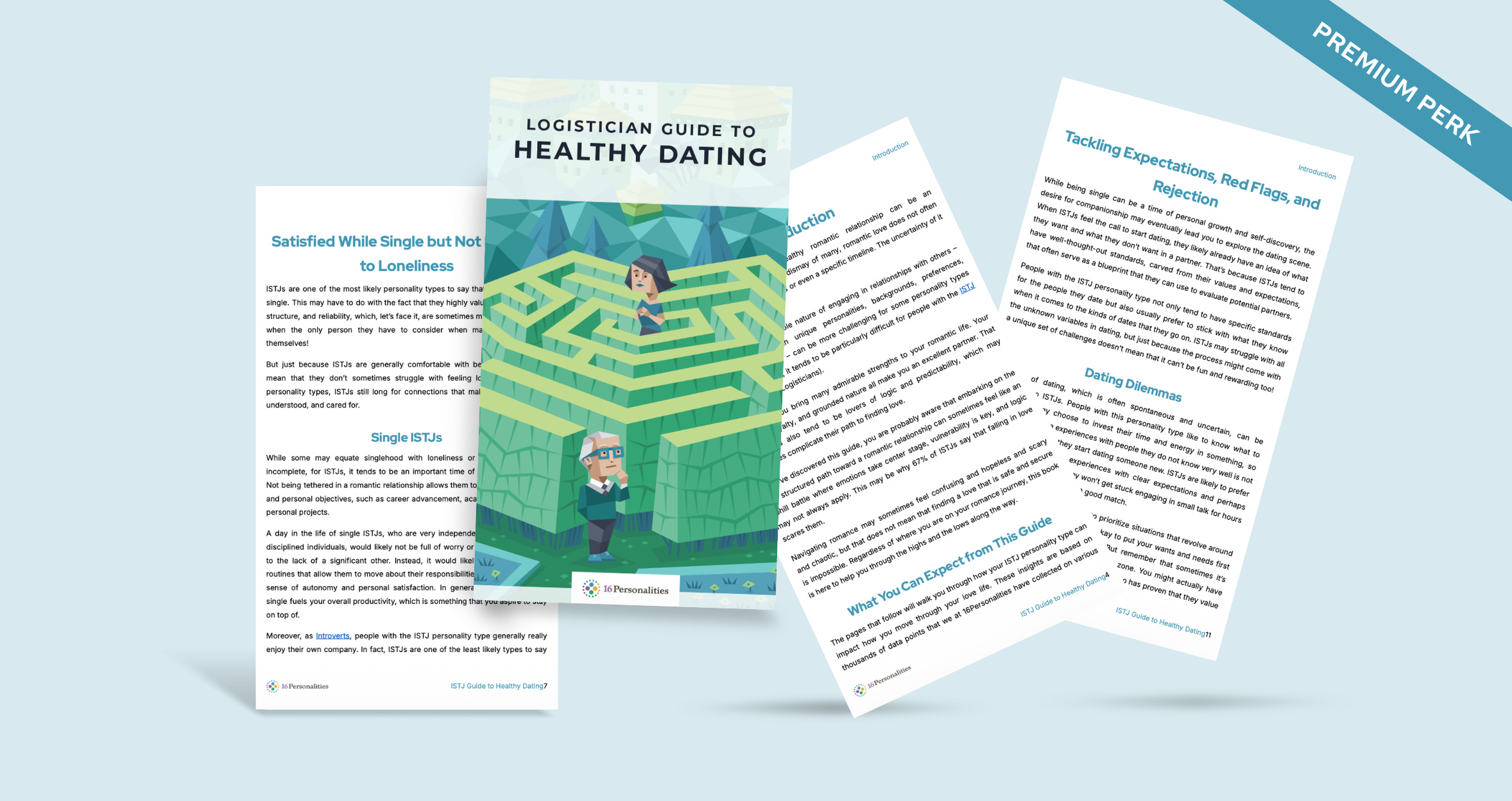
Helping you get there is the goal of the latest e-book we’re releasing to celebrate our Substack Birthday: the Logistician Guide to Healthy Dating, built on more than a decade of personality research on love and relationships.
The Great Birthday Book Drop
This e-book is part of The Great Birthday Book Drop: 14 e-books releasing this month, across a range of personality types. If this one isn’t for your type, check the Perks section – yours may already be available.
To celebrate our birthday, we’re also running a Birthday Sale all September: 50% off an annual premium membership. Which means you can unlock all 14 e-books – plus everything else in our premium content library – for even less.
Let’s get into four things from the guide that every ISTJ should know about dating and love.
4 Things ISTJ Personality Types Should Know About Dating and Love
1. You may be almost too good at being single.
According to our research, ISTJs are one of the personality types most likely to enjoy being single. That makes sense – you highly value personal space, structure, and reliability, which are easier to maintain when the only person you have to consider is yourself. For ISTJs, singlehood tends to be a time of self-empowerment, not worry.
Being comfortable with singlehood doesn’t necessarily suggest an aversion to love. Yet the longer ISTJs remain single, the more likely they are to say they feel less prepared for a relationship and its uncertainties. If you never allocate any time in your busy schedule for dating, your chances of finding someone you can share routines, stories, and love with are a lot smaller.
Sometimes a calculated risk can lead to a positive outcome – and putting yourself out there is exactly that kind of risk.
2. Dating gets easier when you stack the deck toward comfort.
Dating is often spontaneous and uncertain, which can be intimidating for a personality type that likes to know what to expect. So prioritize reliability and comfort: choose dating experiences with clear expectations and maybe even a set timeline, so you won’t get stuck making small talk for hours with someone who might not be a match. It’s okay to put your wants and needs first.
Just balance that comfort with a little exploration. You might have fun trying new activities with someone who has proven they value your time – and you might miss out on a good match if you say no to everything unfamiliar.
ISTJs are the least likely of all 16 personality types to say yes to a second date if they see a red flag of any kind. Sometimes one date really is enough to know. But where there’s ambiguity, consider giving someone another chance – the pressure of a first date rarely brings out anyone’s true self, something you can probably relate to.
3. Falling slowly is fine – just check in with your feelings along the way.
ISTJs are the least likely of all 16 personality types to fall head over heels, and that’s perfectly fine. You’ll probably prefer a slow burn: pumping the brakes when feelings develop and cautiously evaluating the relationship’s potential before letting your emotions take the lead. It’s okay to move at your own pace.
If you’re feeling anxious about developing feelings, try approaching your emotions the way you approach everything else – logically. Write out a pro and con list about your relationship, including emotional factors alongside practical ones. Ask yourself: How does this person make me feel when I’m around them? Do I feel safe, calm, and supported? Am I comfortable expressing my vulnerabilities with them?
A simple evaluation like this can help you get clear with yourself about what you want and where the relationship is heading – without forcing you to do anything before you’re ready.
4. Know your default conflict response.
Understanding how you and your partner normally respond to conflict is imperative for maintaining a healthy relationship. Research has identified four behavioral responses that tend to predict trouble: criticism, contempt, defensiveness, and stonewalling.
For ISTJs, one stands out. About 89% say they usually try to protect or justify their words or actions during relationship conflict – making ISTJs the most likely personality type to admit they default to defensiveness. With your Thinking trait, you may focus on proving your point, which feels right because it’s rooted in your reasoning, rather than truly listening to your partner’s concerns.
The antidote to defensiveness is taking responsibility: accepting that your partner’s perspective and feelings are valid, and apologizing for any wrongdoing. You can’t always predict what will trigger a disagreement, but you do have the power to choose how you respond.
Navigating romance may sometimes feel confusing and chaotic, but that doesn’t mean that finding a love that is safe and secure is impossible. Your practicality, reliability, and strong will are assets – in love as much as anywhere else.
Get the Full Guide
The complete Logistician Guide to Healthy Dating – a focused, 29-page e-book – is now available as a perk for all paid subscribers of Grow with 16Personalities.
The four insights we covered above are just the highlights – the full guide gives you the complete roadmap. Inside, you’ll learn how to:
Understand how ISTJs experience loneliness and rejection, with research data and practical ways to cope with both.
Discover the love languages most likely to appeal to your type, so you and your partner can meet each other halfway.
Handle conflict with antidotes for all four harmful responses, plus a structured, step-by-step framework for resolving disagreements (very ISTJ-friendly).
Understand why ISTJs – who rarely bend over backward for anyone’s approval – may still slip into putting their partner’s needs before their own, and how boundaries and self-love can restore the balance.
Act on a concrete suggestion at the end of every chapter, tailored to wherever you are in your romance journey.
Whether you’re single, searching, or in a committed relationship, this guide will give you an actionable path forward in your love life. Grab your copy below.