


Have you ever felt utterly alone in a crowded room?
This sense of isolation – of being physically present but also miles away – is more common for ENTP (Debater) personalities than you might think. You arrive ready for fun conversations and lively debates, but your enthusiasm isn’t matched. And somewhere between feeling misunderstood and wanting to belong, self-doubt starts to creep in.
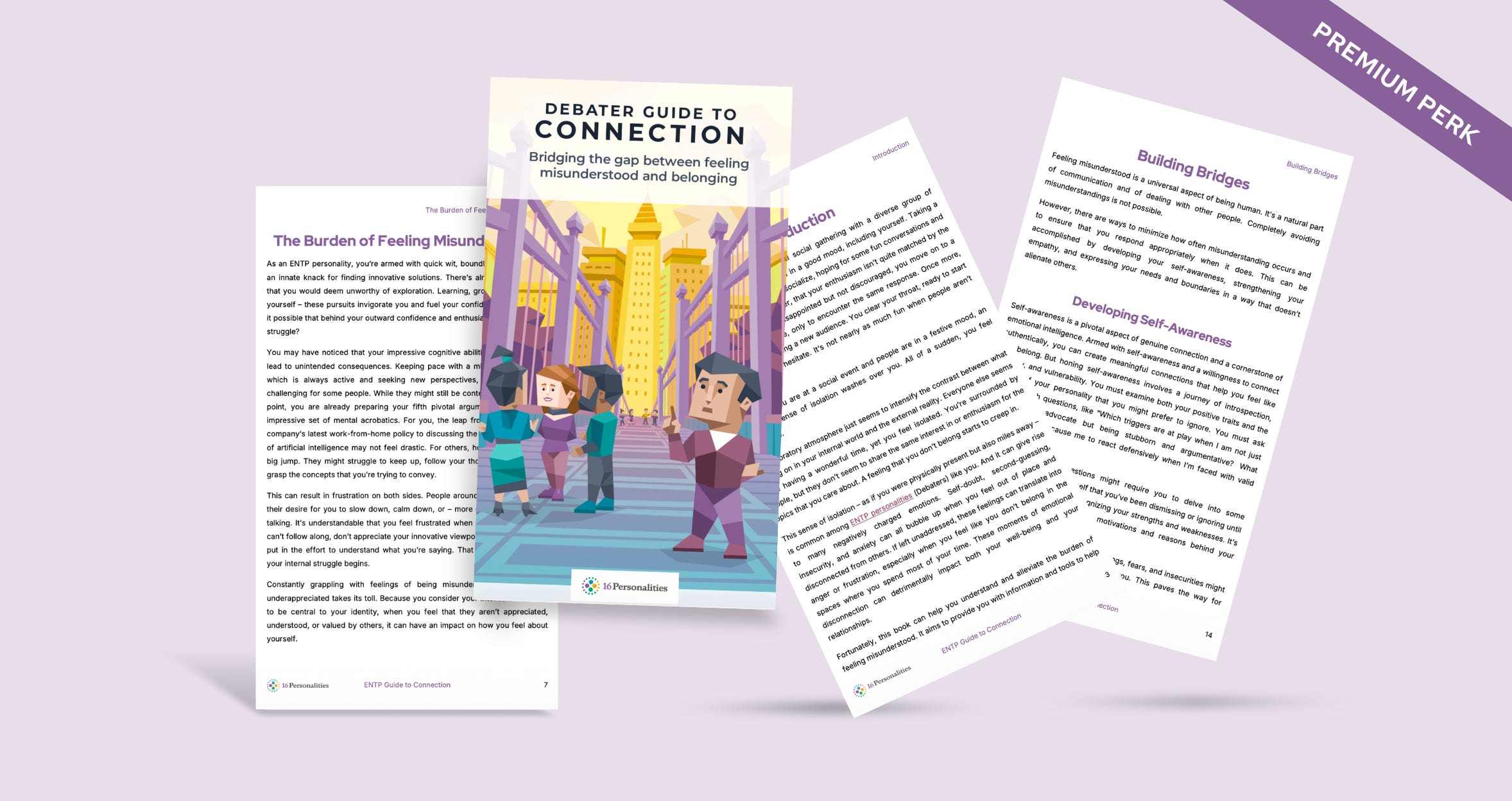
Bridging that gap is the purpose of the latest e-book we’re releasing to celebrate our Substack Birthday: the Debater Guide to Connection, written to help ENTPs find like-minded people who appreciate them for exactly who they are.
The Great Birthday Book Drop
This e-book is part of The Great Birthday Book Drop: 14 e-books releasing this month, across a range of personality types. If this one isn’t for your type, check the Perks section – yours may already be waiting, with the final few arriving soon.
To celebrate our birthday, we’re also running a Birthday Sale all September: 50% off an annual premium membership. Which means you can unlock all 14 e-books – plus everything else in our premium content library – for even less.
Let’s get into four things from the guide that every ENTP should know about building real connection.
4 Things ENTP Personality Types Should Know About Connection
1. Your active mind can outpace the room – and that has consequences.
Your impressive cognitive abilities may lead to unintended consequences. While others are still contemplating your first point, you’re already preparing your fifth pivotal argument. For you, the leap from discussing your company’s work-from-home policy to the ethical implications of artificial intelligence doesn’t feel drastic. For others, it can be a big jump – and what you intend as a fun intellectual exercise may come off as confrontational.
The result can be frustration on both sides. People might ask you to slow down, calm down, or – more devastatingly – stop talking.
That stings because your intellectual abilities are central to your identity, and your self-esteem is built on confidence in them. When others continually fail to recognize those abilities, doubt can creep in and shake the very foundation of that confidence. Recognizing this pattern is the first step to interrupting it.
2. Self-awareness is your bridge across misunderstandings.
Developing self-awareness is an essential tool for navigating misunderstandings – and armed with it, plus a willingness to connect authentically, you can create meaningful connections that make you feel like you belong.
For ENTPs, this means asking yourself some tough questions:
Which triggers are at play when you’re not just playing devil’s advocate but being stubborn and argumentative?
What emotional patterns cause you to react defensively when you’re faced with valid criticism?
The answers may require you to look at some uncomfortable aspects of yourself that you’ve been dismissing until now. (The full guide walks through three simple practices for building this awareness, by the way.)
3. Empathy doesn’t require abandoning your logic.
You might prioritize logical analysis over emotional considerations and conclude that empathy “just isn’t my thing.” But practicing empathy doesn’t mean giving up logical reasoning. Simply acknowledging that others have their own thoughts, emotions, and experiences is the starting point.
For a personality type like yours, the most natural entry point is cognitive empathy – also known as perspective-taking. It’s the ability to understand and imagine what someone else might be thinking or feeling without necessarily experiencing the same emotions yourself. One practical way in is active listening: notice whether you’re truly listening or just waiting to respond, ask clarifying questions, and paraphrase what you heard to confirm it.
Practicing empathy in this way sharpens your understanding of others’ viewpoints, which improves your decision-making and conversation skills. It enables you to craft even more compelling arguments. Empathy doesn’t dull your intellectual edge – it enhances it.
4. The right people will love a good debate as much as you do.
Your sharp wit, quick thinking, and tendency to push boundaries might not be everyone’s cup of tea, and that’s okay. You don’t have to connect with everyone you meet, especially people you can’t be fully yourself around.
There are people out there who find it invigorating to get into a heated debate with a friend, shake hands afterward, and say they look forward to doing it again sometime. People who want to dig into how automation will shape the future of work or how biotechnology will impact biodiversity. Why not find them?
Start by identifying your interests and passions: Is it debate itself that excites you, or a particular subject, hobby, or cause? Compare that list with the people and groups you currently spend time with, and notice the gaps. Then explore online forums, interest-based groups, and social gatherings where those passions live. And if a community doesn’t celebrate your unique perspective, it’s okay to keep looking – the right one will.
True belonging means being accepted as your authentic self, without having to mask your true feelings. Your people might challenge you, might debate you, might argue with you – but at the end of the day, they respect and appreciate you, even when they don’t agree with you on everything.
Get the Full Guide
The complete Debater Guide to Connection – a short but powerful 26-page e-book – is now available as a perk for all paid subscribers of Grow with 16Personalities.
The four insights we shared today open the conversation – the full guide finishes it. Inside, you’ll learn how to:
Pinpoint the five root causes of why ENTPs feel misunderstood, from complexity of thought to playing devil’s advocate.
Recognize the six ways chronic misunderstanding can take a toll, from self-doubt to doubling down, before they erode your confidence.
Build self-awareness with step-by-step instructions for journaling, mindfulness, and meditation (no witnesses to the beginner phase required).
Express your needs and boundaries without alienating others, using strategies that play to your knack for a well-made argument.
Find and build communities where your love of debate is celebrated, not merely tolerated.
If you’re ready to feel heard, seen, and appreciated – all without compromising your authentic ENTP self – grab your copy now.